Portfolio
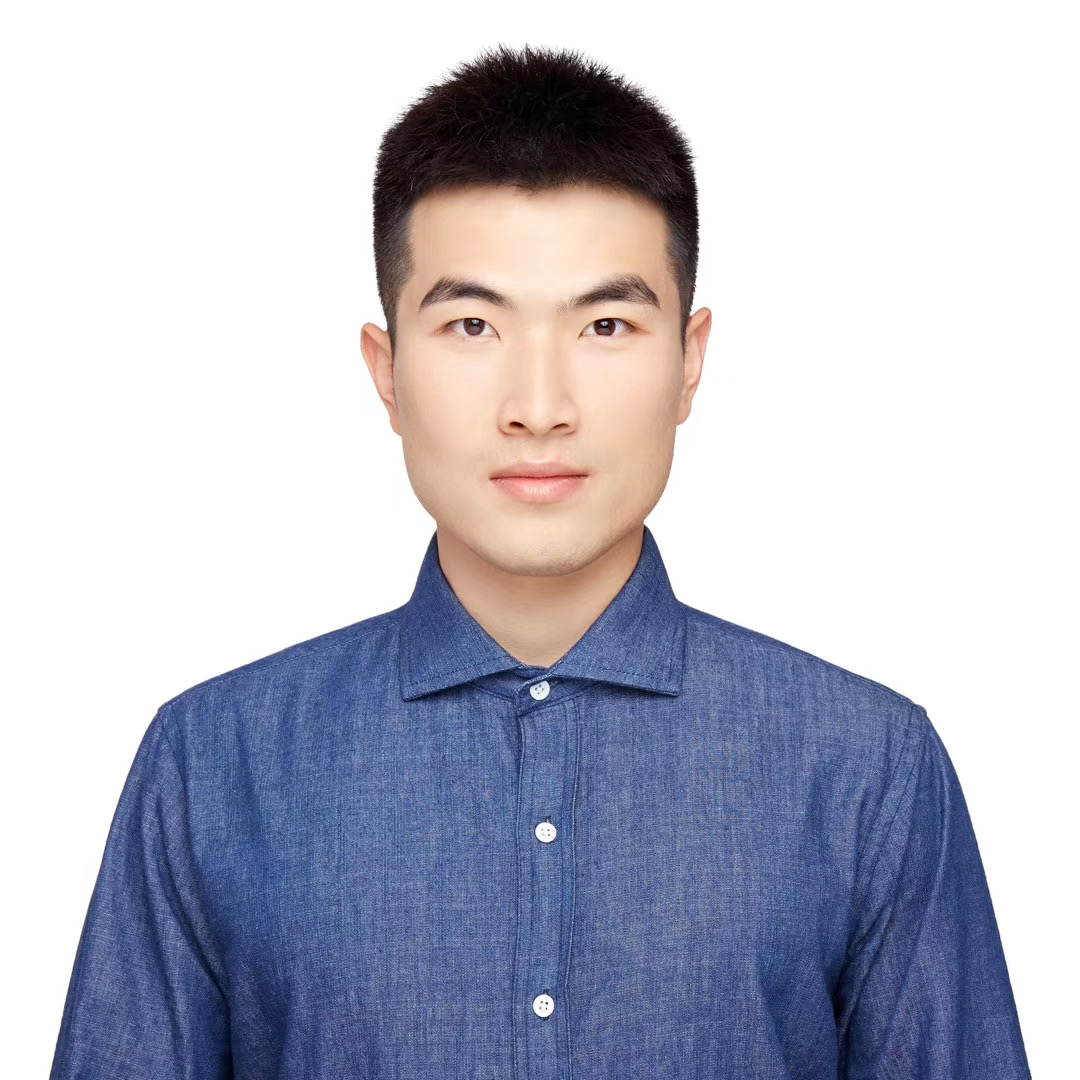
Guanli (Leo) Liu · Databases · Data Storage · Research Engineering
I build data and AI systems, then turn them into reproducible, measurable products.
Now at Microsoft Azure Storage, previously a Research Fellow at the University of Melbourne. My research covers data lakes and distributed databases, storage and indexing, query optimization and database tuning, and benchmarking.
Research Interests
Database and storage systems: how data is organized, how queries are optimized, and how performance is evaluated.
Featured Build Stories
Projects are presented as build stories: problem context, technical implementation, and measurable outcome.
DriftBench
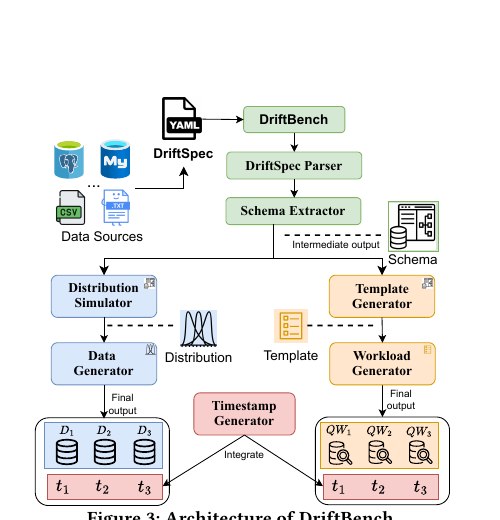
Built a full-stack drift-aware benchmarking system that helps database researchers generate, reuse, and reproduce evolving datasets and workloads with reproducible pipelines and release automation.
Stack: Python, CLI workflows, workload/data generators, CI/CD pipelines, benchmark automation.
AI-DB Extension Benchmark
Built a benchmark and evaluation workflow for AI-DB as a PostgreSQL extension, with recent integration of three core projects: HMAB, GRASP, and CoLSE, enabling unified testing and comparison under one extension-oriented runtime.
Stack: PostgreSQL extension workflows, Python automation, reproducible benchmark harnesses, performance analysis.
LayoutPilot / Layout Advisory
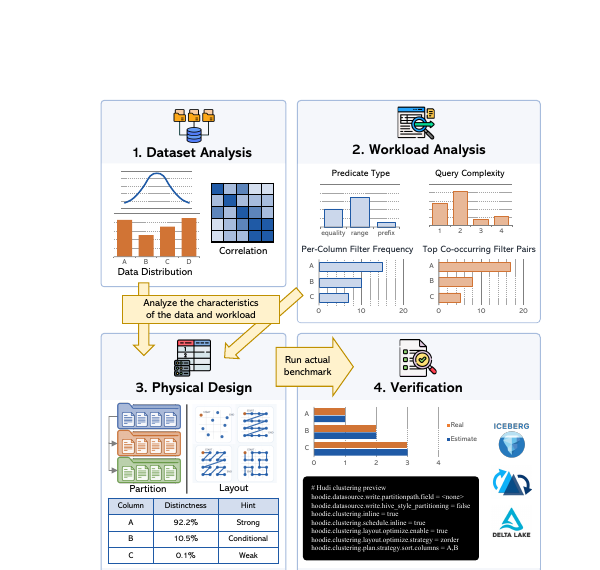
Designed an advisory backend for analytical data lake workloads, including workload ingestion, SQL parsing, and reusable decision logic for partitioning and intra-file layout choices.
Stack: Python, SQL parsing workflows, experiment harnesses, Dockerized service environment.
Metadata-Native Agent Workspace Infrastructure
Proposed and prototyped an infrastructure direction where metadata drives task-aware context routing, access control, and recoverable actions for agent workflows.
Public write-up and architecture notes will be published in an upcoming portfolio update.
LLM-Assisted Query Agents
Developed agents that translate natural language requests into executable database workflows through retrieval, query decomposition, and result-grounded evaluation.
Selected Publications
This section now reads from structured data and will be connected to the Scholar sync harness in the next workflow steps.
CoLSE: A Lightweight and Robust Hybrid Learned Model for Single-Table Cardinality Estimation using Joint CDF Published
Benchmarking RL-Enhanced Spatial Indices Against Traditional, Advanced, and Learned Counterparts Published
LayoutPilot: A Lakehouse Physical Design Advisor Published
Toward Drift-Aware Database Benchmarking DriftBench Published
Efficient Cost Modeling of Space-filling Curves Published
Efficiently Learning Spatial Indices Published
Efficient Index Learning via Model Reuse and Fine-tuning Published
Effectively Learning Spatial Indices Published
Build Queue (Next Portfolio Drops)
- Blockchain Data Platform at nftDb: Kafka + Airflow ingestion and BigQuery analytics workflow case study.
- Baidu IM Backend: message protocol and deduplication reliability engineering breakdown.
- Evaluation Tooling: reusable experiment templates and CI-style benchmark validation pipeline.
Work Experience
Jun. 2026-Present: Azure Storage, Microsoft (Melbourne, Australia).
2024-May 2026: Research Fellow, The University of Melbourne (Melbourne, Australia).
Led research and engineering projects on database benchmarking, indexing, data layout, and AI-driven query processing.
Designed system prototypes, supervised junior researchers, and co-supervised master's students on spatial indexing and database systems.
Built backend systems and reproducible evaluation pipelines for data and AI workloads.
2023-2024: Data Scientist / Data Infrastructure Engineer, nftDb (Melbourne, Australia).
Built blockchain ingestion pipelines, dbt and SQL analytics workflows, and BigQuery-based analysis.
Developed an internal RAG assistant for engineering knowledge retrieval.
2019-2023: PhD Researcher, The University of Melbourne (Melbourne, Australia).
2015-2017: Software Engineer, Baidu (China).
Worked on large-scale messaging systems and protocol design for internal communication platforms.
Improved message deduplication and database performance in production backend services.
Mentoring, Teaching, and Research Service
Mentoring and Supervision
- Co-supervising master's students on research projects in spatial indexing and database systems.
- Supervising junior researchers in reproducible benchmarking and AI-driven data systems projects.
Teaching
- COMP90018 - Android Application Development (The University of Melbourne): Tutor (Aug. 2019 - 2023), Responsible for tutorials, student support, and assessment marking.
- COMP90041 - Programming and Software Development (The University of Melbourne): Tutor (Aug. 2019 - 2023), Responsible for tutorials and assessment marking.
Research Service
- Conference Reviewer: SIGMOD 2026, ICDE 2027, VLDB 2027/2026/2025, KDD 2026/2025 (Excellent Reviewer).
- Journal Reviewer: TKDE, WWW, and Transactions on Spatial Algorithms and Systems (TSAS).